


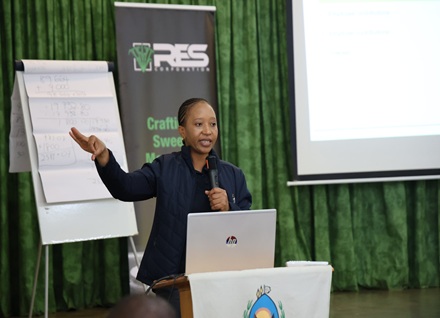
Employees of the Royal Eswatini Sugar Corporation (RES) have completed a two-week tax education programme facilitated by the Eswatini Revenue Service (ERS), following requests by staff for clarity on Pay-As-You-Earn (PAYE) deductions.
The training comes after a series of engagement sessions led by the Human Capital Department as part of a culture feedback process initiated in 2025. The process was aimed at addressing concerns around workplace culture, including what employees described as a toxic work environment. During the feedback sessions, employees appealed to management to provide education on taxation, citing concerns that they were being overtaxed.
In response, the Payroll Department, in partnership with ERS, organised the tax education sessions.
Speaking as co-host of the sessions, General Manager Finance, Dumi Dhliwayo, said the objective was to strengthen employees' understanding of how PAYE is calculated and deducted.
"Employees are more likely to accept their tax obligations when they understand why and how they are taxed. The session also provided an opportunity to raise awareness of new taxation of employee benefits practice notes introduced by the ERS that directly affect PAYE," Dhliwayo said.
He said the programme covered the tax treatment of basic salary and fringe benefits, employer remittance of PAYE to ERS, tax certificates and payroll records, and the respective responsibilities of employers and employees under the PAYE system.
Dhliwayo noted that common concerns raised with the Payroll Office include understanding payslip layout and its relation to the IRP5 tax certificate, distinguishing between taxable income, allowable deductions and rebates, resolving PAYE discrepancies under the Final Deduction System (FDS), and how tax refunds are determined.
He said the sessions will improve transparency and trust between employees and the Payroll Office, creating an open platform for employees to raise questions.
"We encourage employees to take an active interest in understanding their payslips and how their taxes are calculated," he said.
ERS Senior Officer and Tax Educator, Thulile Simelane, said the main purpose of the sessions was to enhance understanding of the Eswatini tax system, particularly taxation of employment income and PAYE calculation.
The sessions covered PAYE requirements, employers' responsibilities, definition of remuneration and taxable remuneration, computation of taxable employment income, taxation of non-cash benefits, applicable tax rates, allowable deductions and rebates, and requirements for filing individual income tax returns.
"These topics are important because they enable employees to understand how their tax liabilities are determined and help them comply with their tax obligations," Simelane said.
She said a common misconception among employees is that PAYE is calculated on basic salary only, while in reality it is calculated on total remuneration, which includes salary, allowances, overtime, bonuses and taxable non-cash benefits such as housing, rations, utilities, soft loans and other benefits.
On compliance, Simelane said some employees who earn additional income from rentals or businesses fail to file annual returns, resulting in penalties. She added that employees often overlook public notices issued by the Commissioner General outlining filing obligations.
Simelane said ERS promotes compliance through taxpayer education, face-to-face and virtual workshops, social media platforms, radio and television programmes, mobile tax clinics during filing season, and support through Client Relationship Consultants and service centre kiosks.
Employees who attended the sessions said the training had improved their understanding.
IT Master Data Officer, Sifiso Makhubu, said the session gave him a clearer understanding of his payslip structure and how taxable benefits affect overall income.
"The most eye-opening lesson was understanding how PAYE is calculated and how different benefits received from an employer can form part of taxable income," he said.
Creditors Controller, Nofundo Mtsetfwa, said the training helped her understand cash and non-cash benefits and how to calculate PAYE deductions and net salary.
"This knowledge will help me become more proactive in managing my personal tax compliance by regularly reviewing my payslip and ensuring my tax information is accurate and up to date," she said.
Both ERS and RES management encouraged employees to take advantage of continuous tax education opportunities and to seek clarification whenever uncertain about tax matters.
Date : 2026-10-14 Read more
Date : 2026-10-16 Read more
Date : 2026-08-13 Read more

RES Corporation P. O. Box 1 Simunye L301
 +268 2313 4000
+268 2383 8953
